
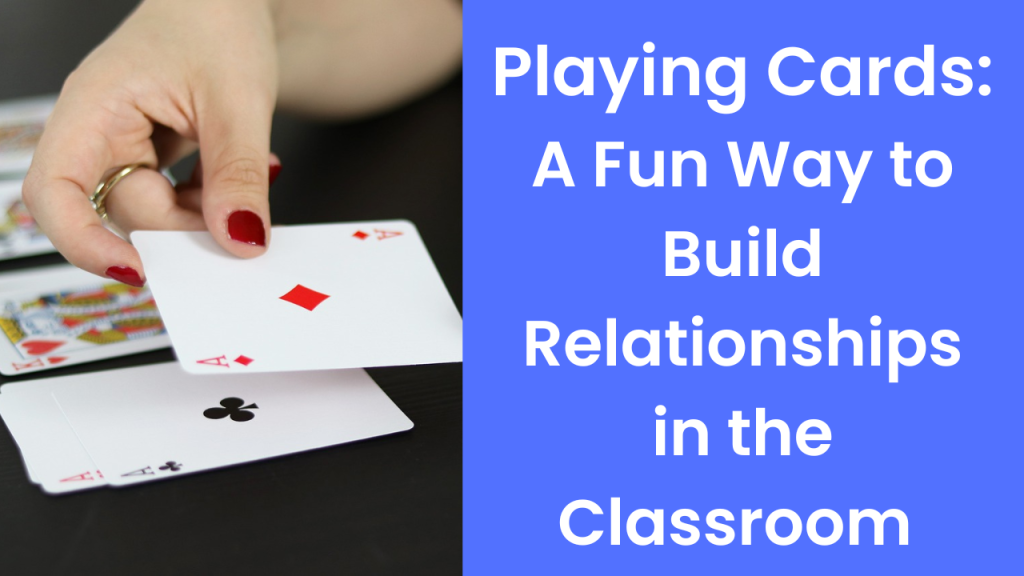
One of my favorite ways to build relationships in the classroom is by playing card games. Lots of teachers use cards to practice different skills in the classroom like place value, multiplication, fractions, and even integers. However, in my middle school math class, I find cards are an invaluable way to help students get to know one another, and you, in a structured way.
Some other positives to playing cards are that they are fairly inexpensive and buying class sets won’t break the budget. Game days offer a way to reward students without spending a lot of your own money. Plus, students are learning strategizing, problem solving, and social skills all while having fun.
In this post, I am going to give you 3 tips for integrating playing cards into your classroom.
Tip #1: Don’t assume they know anything about a regular deck of playing cards.
Students today don’t play card games. A few may have been exposed to an online version of solitaire but that is often the limits of their knowledge of card games using a regular deck of cards. Many of my students don’t even have decks of cards at home and are starting from a knowledge base near zero.
So, during the first week of school when we are working on building community and getting to know each other, I introduce a regular deck of playing cards. I ask them questions such as:
- How many cards are in a regular deck?
- How many suits are there? What are they?
- How many cards are in each suit?
- What is a face card?
- What are the different face cards?
- What is the difference between a Jack and Joker?
- Which is higher in value: a Jack or a King?
- What is an Ace? Is it a high card or a low card?
- What is a “one-eyed” Jack?
I make sure they have visuals of different decks because a Jack on one deck may not look exactly like a Jack on another deck.
Tip #2 Start with “easy” card games.
The first game I introduce is “Go Fish.” I am always amazed at how many students don’t know how to play this basic card game. Some of the reasons I choose this card game first are:
- The rules are simple. My English language learners can catch on easily as well as my students receiving special services. They can even teach it to their younger siblings if they have playing cards at home.
- The students get to practice each other’s names. “Jorge, do you have any 3’s?” – Click here for my free name tent activity that helps with this.
- The students get to practice the names of the face cards. Invariably, each year, I have multiple students who say, “Do you have any K’s?” instead of “kings.”
Other easy games that I introduce later in the year, include Old Maid, War, Speed, Crazy Eights, and Snap.
I always leave a copy of the written rules on the table as well for students to refer to. The rules to most of the games we play are in my Free Resource library which you can join by clicking here.
Tip #3 Change up the groups and join in.
Changing up the groups will help the students get to know more people in the classroom. It will keep some students from feeling left out and build confidence because the games are a structured way to interact. Then, when you need them to interact with each other regarding the actual content, they will feel more comfortable.
Whenever possible, the teacher should join in. Students love nothing more than to best a teacher at any game…not that you should let them win. Sitting at a table playing cards is just relaxing and you get to know your students on a more personal level. You may find you learn some interesting things about them.
Sometimes, I even invite administrators to play with the students. If beating the teacher is fun, think how much fun it is to trounce the principal.
Finally, it always warms my heart to see students start carrying around their own decks of cards at school. Sometimes I see them before school or at lunch involved in intense games of speed or war.
Decks of cards would also make an excellent addition to your prize box, especially if you can get them donated.
If you found this post interesting, you may want to check out this post on teaching probability with playing cards and these activities in my TPT store.


If you try playing cards games to build relationships in your classroom or have other suggestions, please comment below. I would love to hear your ideas.
